Medical records · AI
AI medical chronology
An AI medical chronology uses machine reading to turn thousands of pages of medical records into a dated, cited timeline of care. Done right, it collapses weeks of review into hours. Done wrong, it produces a fluent summary you can't rely on. The difference is not the model — it's the verification architecture around it.
How an AI medical chronology is built
The pipeline has four stages. First the production is split and classified — a 4,000-page PDF becomes the individual charts, reports, and bills it actually contains. Then each page is read and extracted: encounters, findings, diagnoses, procedures, and medications, each with a date, a provider, and a pointer to its source page. Third, entities are resolved across documents, so "R. Smith," "Robert Smith," and "the patient" become one person with one history, and duplicate records collapse into one event. Finally the events are ordered and assembled into a chronology you can filter, annotate, and export.
Where AI chronologies go wrong
Four failure modes account for nearly every AI chronology horror story: invented events (the model summarizes what records like this usually say), wrong dates (a fax header mistaken for a service date), merged identities (two patients or providers with similar names), and uncited claims (a conclusion with no way to check it). None of these are solved by a better model alone — they're solved by refusing to let unverified output into the record.
What makes an AI chronology trustworthy
| Risk | Control |
|---|---|
| Invented or embellished events | Every entry cites its source page; verbatim entries are machine-checked against the document at ingest. |
| Wrong dates | Dates carry their context (service date vs. record date vs. transmission date) and low-confidence dates are flagged for review. |
| Merged or split identities | Entity resolution is explicit and reviewable — merges are suggested, not silently applied. |
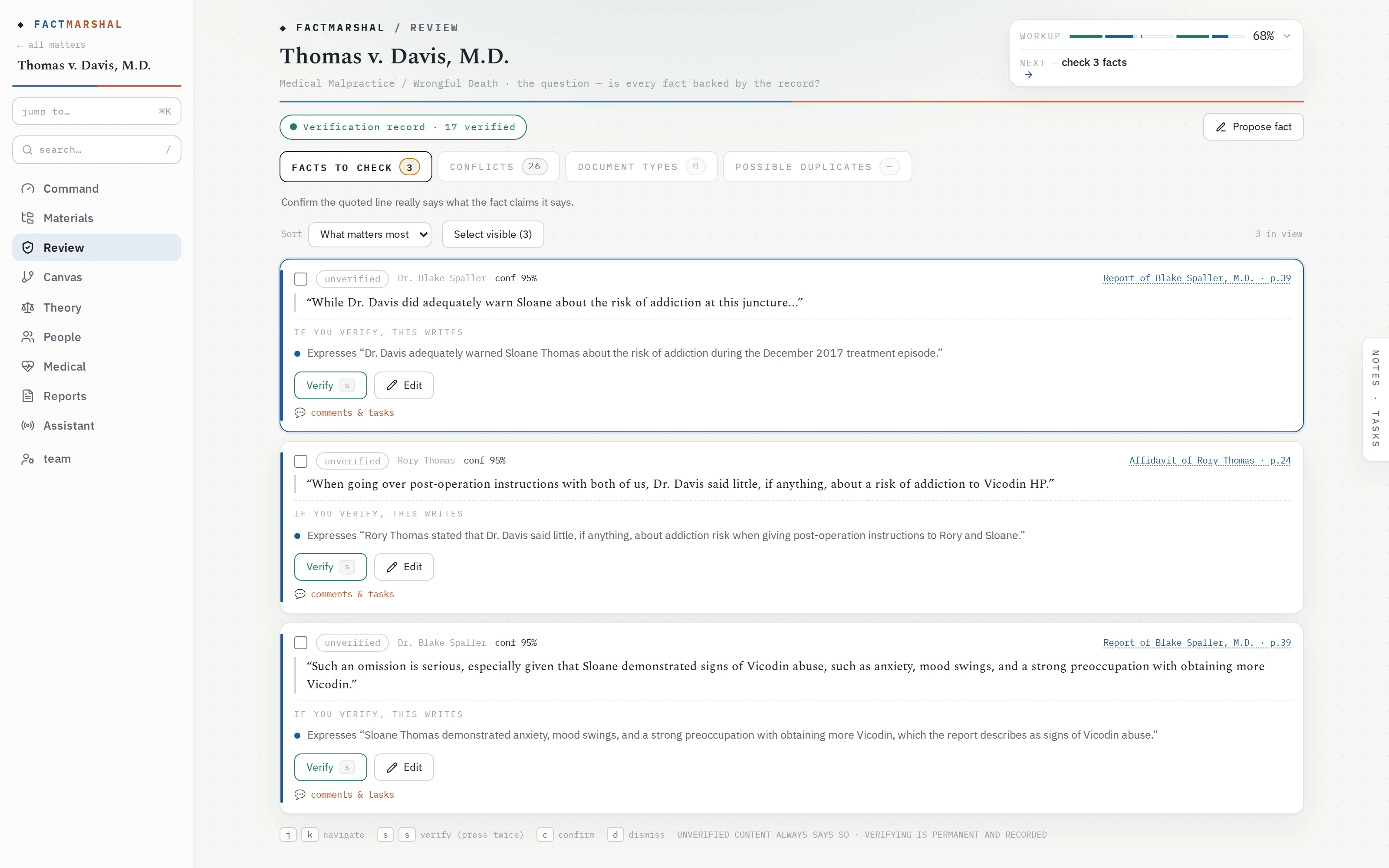
| Silent errors compounding downstream | A review queue separates verified from unreviewed entries, so you always know what the chronology's conclusions rest on. |
The FactMarshal approach: verification as the product
FactMarshal was built citation-first rather than chat-first. The AI does the reading; the system enforces that every fact is pinned to its page; verbatim facts verify automatically; a human confirms the rest at reading speed. The result isn't an AI summary of the records — it's a verified fact record that happens to have been assembled by AI, with the chronology, the contradiction report, and the deposition outline all drawing on the same checked foundation.
Frequently asked questions
- Will an AI chronology miss things a nurse reviewer would catch?
- AI reads every page with the same attention, which humans reviewing thousands of pages demonstrably do not. What AI lacks is clinical judgment about significance — which is why FactMarshal keeps a human in the loop: the AI does the exhaustive reading and extraction, your team does the judging, with the source page one click away.
- Can I verify any entry in the chronology?
- Yes. Every entry links to the exact page and passage it came from. Entries whose text is verbatim from the record are machine-verified at ingest; the rest are marked for review until a person confirms them. You always know which parts of the timeline are verified.
- What about handwriting and poor-quality scans?
- Illegible content is the honest limit of every AI system. FactMarshal flags low-confidence extractions rather than guessing, so ambiguous pages go to a human instead of silently entering the record wrong.
- Are our records used to train AI models?
- No. Client files are never used to train models — ours or anyone else’s — and each firm’s data is isolated at the tenant level with matter-scoped access controls.
- Can it flag conflicts between the records and testimony?
- Yes. Because the chronology and the rest of the case file live in one fact record, FactMarshal surfaces contradictions between medical events and deposition or pleading statements side-by-side, each with its citation.