Depositions
Deposition summary software
A deposition summary condenses a transcript into the statements that matter — admissions, denials, inconsistencies — each with a page:line citation. Deposition summary software drafts those summaries from the transcript itself, and the good tools go further: they check what the witness said against what the record shows.
The three deposition summary formats
| Format | What it is | Best for |
|---|---|---|
| Page-line | Sequential condensation with page:line cites, typically 10:1 or tighter | Motion practice, designations, trial prep — the litigation standard |
| Topical | Testimony regrouped by subject (prior injuries, the incident, damages) | Multi-witness cases; comparing accounts across deponents |
| Narrative | Readable prose summary of the testimony | Client updates, carrier reports, early case assessment |
What AI changes — and what it doesn't
Summarizing a 300-page transcript by hand takes a day or more per witness; AI does the condensation in minutes and never gets tired on page 250. What AI doesn't change is the standard the summary has to meet: if a summarized admission can't be traced to its page and line instantly, it isn't work product — it's a rumor about the transcript. That's why citation-per-statement is the non-negotiable feature, not summary speed.
Beyond the summary: testimony against the record
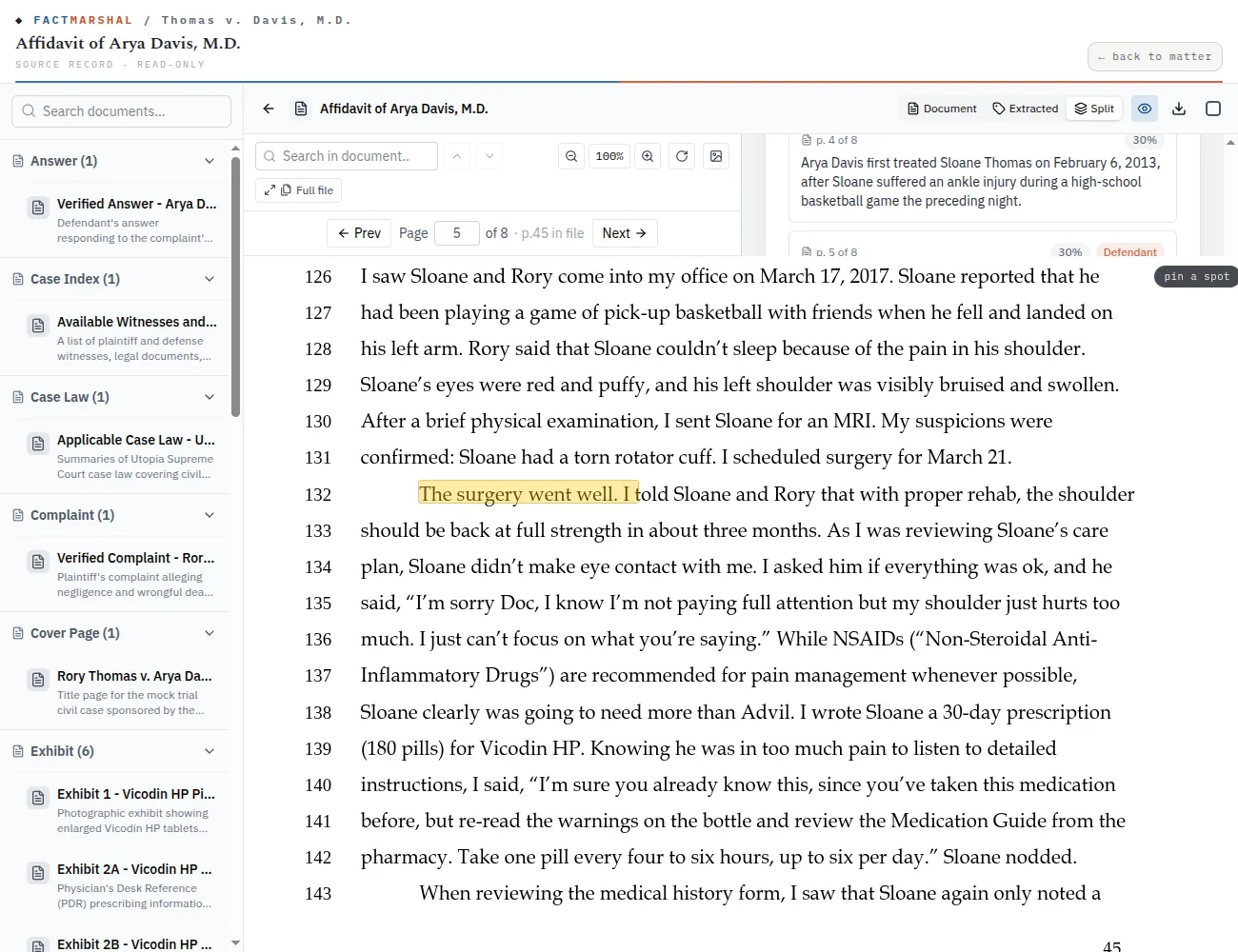
A transcript is most valuable when it disagrees with something. In FactMarshal, testimony enters the same verified fact record as the medical records, pleadings, and discovery — so inconsistencies surface automatically: the intake form against the deposition, one deponent against another, this year's testimony against last year's affidavit. Each flag shows both statements side-by-side with citations, ready for the errata fight or the cross.
How FactMarshal handles a transcript
Upload the transcript into the matter. Statements are extracted with page:line citations and classified — admissions, denials, foundation, credibility. Summaries in any of the three formats draw from that analysis; the contradiction engine checks the testimony against the existing record; and flagged statements feed directly into the chronology and the next witness's outline. One reading, every downstream use.
Frequently asked questions
- What summary formats does deposition summary software produce?
- The three standard formats: page-line summaries (condensed testimony with page:line citations, the litigation workhorse), topical summaries (testimony organized by subject across the transcript), and narrative summaries (readable prose for client or carrier updates). The right tool produces all three from the same underlying analysis.
- How accurate are AI deposition summaries?
- Accurate summarization is table stakes; the real question is checkability. In FactMarshal every summarized statement carries its page:line citation back to the transcript, so a claimed admission is one click from the testimony itself — and anything the AI flags is a lead to verify, not a conclusion to trust blindly.
- Can it find contradictions between testimony and the documents?
- Yes — this is where FactMarshal differs from pure summarization tools. Testimony joins the same fact record as the medical records, pleadings, and productions, so "I was never treated for my back" gets flagged against the two-year-old MRI report automatically, with citations to both.
- Does it help with deposition prep, not just summaries after the fact?
- Yes. Because the fact record exists before the deposition, FactMarshal supports outline building from the facts a witness needs to be examined on — each question’s predicate cited — and after the transcript arrives, the loop closes: new testimony is checked against the record.
- What transcript formats are supported?
- Standard transcript PDFs and text formats as delivered by court reporters. Exhibits referenced in the transcript live in the same matter, so citations resolve to real documents.