The litigation stack
Litigation management software
“Litigation management software” gets used for three different jobs: running the business of a case, processing discovery at scale, and mastering the facts. Most firms have bought software for the first two — and still do the third, the one that decides outcomes, in spreadsheets and late nights.
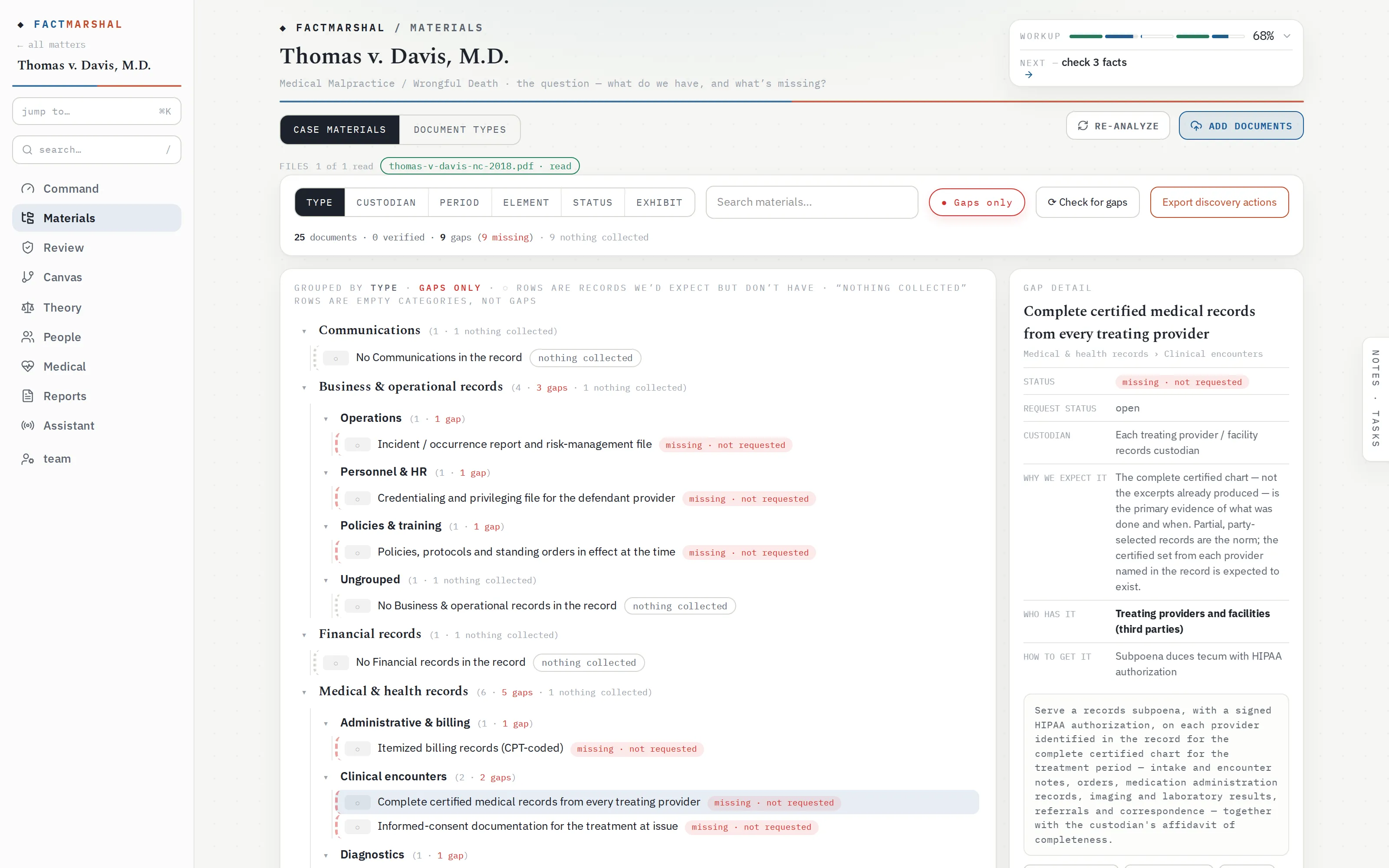
The three layers of a litigation stack
| Layer | The job | Typical tools |
|---|---|---|
| Practice management | Intake, calendaring, tasks, time and billing, document storage | Clio, Filevine, MyCase, Litify |
| Ediscovery | Collection, processing, review at scale, production | Everlaw, Relativity, DISCO |
| Litigation intelligence — the fact layer | What actually happened: verified facts, chronology, contradictions, testimony against the record | FactMarshal |
The first two layers manage the case's logistics and its documents. Neither answers the
questions the case turns on: what does the record actually establish, in what order, and
where does it disagree with itself? That's the fact layer, and in most firms it's a
spreadsheet named chronology_v7_FINAL.xlsx.
What the fact layer does
FactMarshal reads the whole file — pleadings, records, transcripts, productions — and builds a verified fact record: every fact dated, categorized, and pinned to its source page. Verbatim facts are machine-verified; the rest pass through a review queue built for speed. From that record come the chronology, the contradiction report, deposition outlines, and a case assistant whose every answer cites its way back to the page. The work product your team used to assemble by hand becomes a view of a record they've already verified.
Alongside your stack, not instead of it
Keep your practice management system for running the matter and your review platform for discovery. FactMarshal takes what those systems hold and makes it usable at the level litigation is actually fought — facts, sequence, and credibility. That's also the honest way to evaluate us: bring a closed matter to the demo and see what the record was hiding.
Frequently asked questions
- Is FactMarshal a case management system?
- No, and we won’t pretend to be. Practice management systems run the business of a case — intake, calendaring, tasks, billing, documents. FactMarshal is the fact layer: it reads the case file those systems store and turns it into a verified record of facts, chronologies, and contradictions. Most customers run it alongside their existing practice management system.
- Does FactMarshal replace our ediscovery platform?
- No. Ediscovery platforms are built for collection, processing, and large-scale review before production. FactMarshal works downstream of production: once documents are in the case, it builds the fact-level understanding — what happened, when, said by whom, and where it conflicts.
- What does it work with?
- FactMarshal works from the files you already have — PDF productions, pleadings, medical records, transcripts — regardless of which systems produced them. Ask us about integrations with your practice management or document management stack.
- How is our data protected?
- Each firm’s data is isolated at the tenant level, access is scoped per matter with lead, member, and viewer roles, and client files are never used to train models.
- Who is FactMarshal for?
- Litigation teams — plaintiff and defense — where mastering a large factual record decides outcomes: PI and med-mal, employment, commercial disputes, and any matter where the file outgrows what a spreadsheet chronology can hold.