Personal injury
Personal injury case management software
PI case management software keeps matters moving — intake, deadlines, documents, liens, settlement tracking. But the work that decides case value — reading the medical records, building the chronology, catching the contradiction before the defense does — usually still happens in spreadsheets and late nights. That's the layer FactMarshal adds.
What a PI practice actually needs from software
| The job | Which layer does it |
|---|---|
| Intake, deadlines, tasks, documents, liens | Your case management system (Filevine, Clio, Litify, MyCase…) |
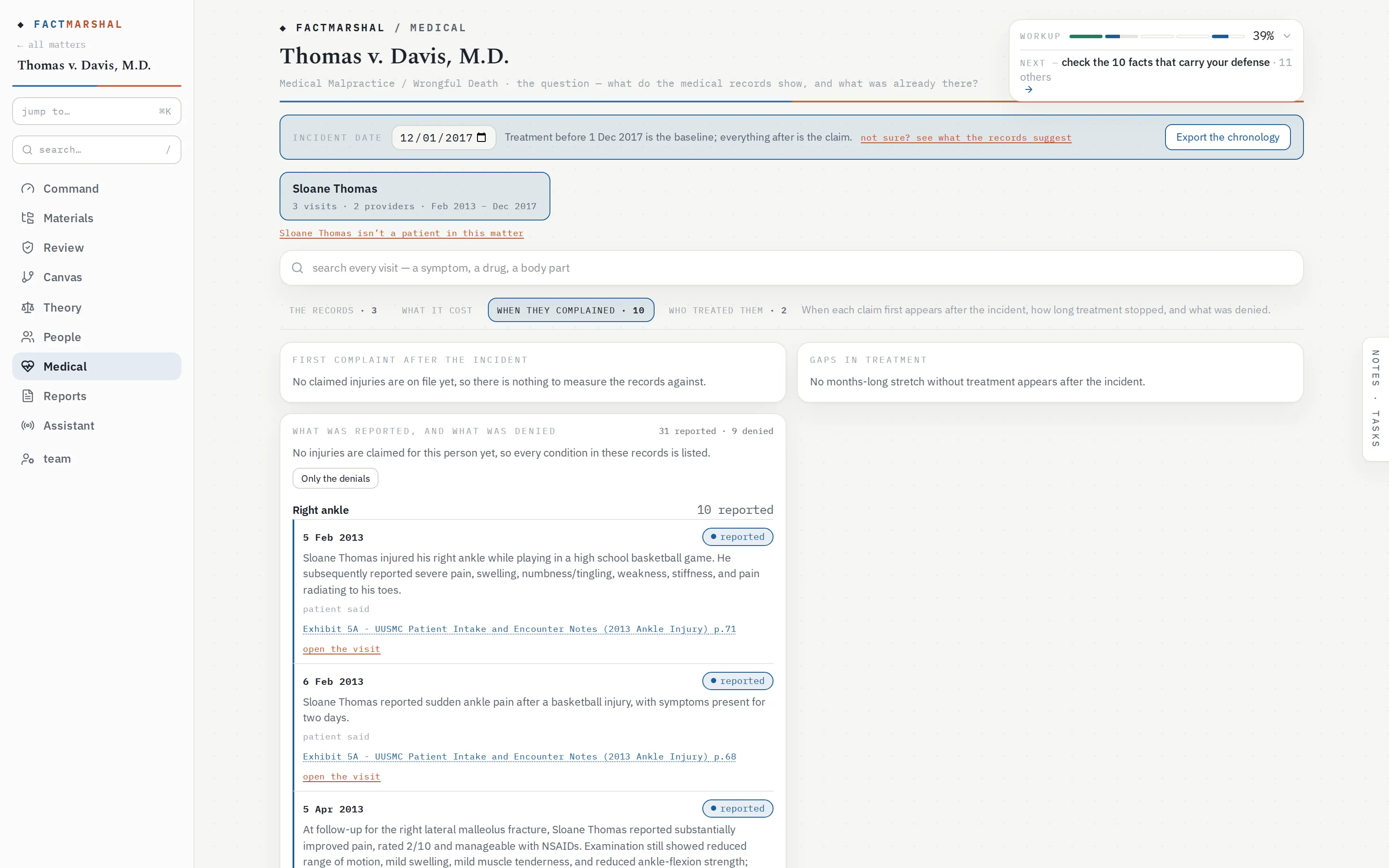
| Reading thousands of pages of medical records | FactMarshal — the fact layer |
| A verified medical chronology with source-page citations | |
| Catching contradictions between records, intake, and testimony | |
| A cited factual foundation for demands, mediation, and trial |
The medical-record problem
Case value lives in the records: the treatment gap the adjuster will find, the prior injury on page 3,112, the provider note that contradicts the intake form. Reviewing them by hand costs paralegal weeks per matter; skipping the deep read costs settlements. FactMarshal reads every page, builds the chronology with each event pinned to its source, machine-verifies verbatim facts, queues the rest for one-click review — and then does the thing spreadsheets never will: it cross-examines the record against the testimony automatically.
Where it pays off in the PI lifecycle
Case evaluation: know what the record supports before you invest. Treatment monitoring: gaps and inconsistencies visible as records arrive, not at demand time. The demand: a chronology you verified underpinning numbers you can defend. Depositions and trial: impeachment material — prior inconsistent statements against the chart — surfaced with citations to both sources. The firms that win on facts aren't reading more; they're verifying faster.
Frequently asked questions
- Is FactMarshal a replacement for Filevine, Clio, or Litify?
- No. Those systems run the business of a PI practice — intake, deadlines, documents, settlement tracking — and they’re good at it. FactMarshal adds the layer they don’t do: reading the medical records and the rest of the file, building the verified chronology, and catching contradictions. It runs alongside your case management system, not instead of it.
- What PI-specific work does FactMarshal actually do?
- Medical chronologies with source-page citations and treatment gaps made visible; contradiction detection between records, intake forms, and deposition testimony; entity resolution across providers; and a verified fact foundation for demand packages, mediation, and trial.
- Does it work for a small firm, or only high-volume practices?
- The economics work anywhere record volume is the bottleneck. A three-attorney firm drowning in a med-mal record benefits the same way a high-volume PI shop does — the difference is how many matters run through it.
- How is client medical data handled?
- Firm data is isolated at the tenant level, access is scoped per matter with lead, member, and viewer roles, and client files are never used to train models. Ask us about our security posture during the demo.
- What does it cost?
- Pricing depends on firm size and matter volume. Request a demo — bring a closed matter and judge the output before we talk numbers.