Medical records
Medical chronology software
A medical chronology is a date-ordered account of every medically significant event in a patient's records — visits, diagnoses, imaging, medications, procedures — each tied to the page that proves it. Medical chronology software builds that account from the raw records automatically, so your team spends its time reviewing the chronology instead of retyping the chart.
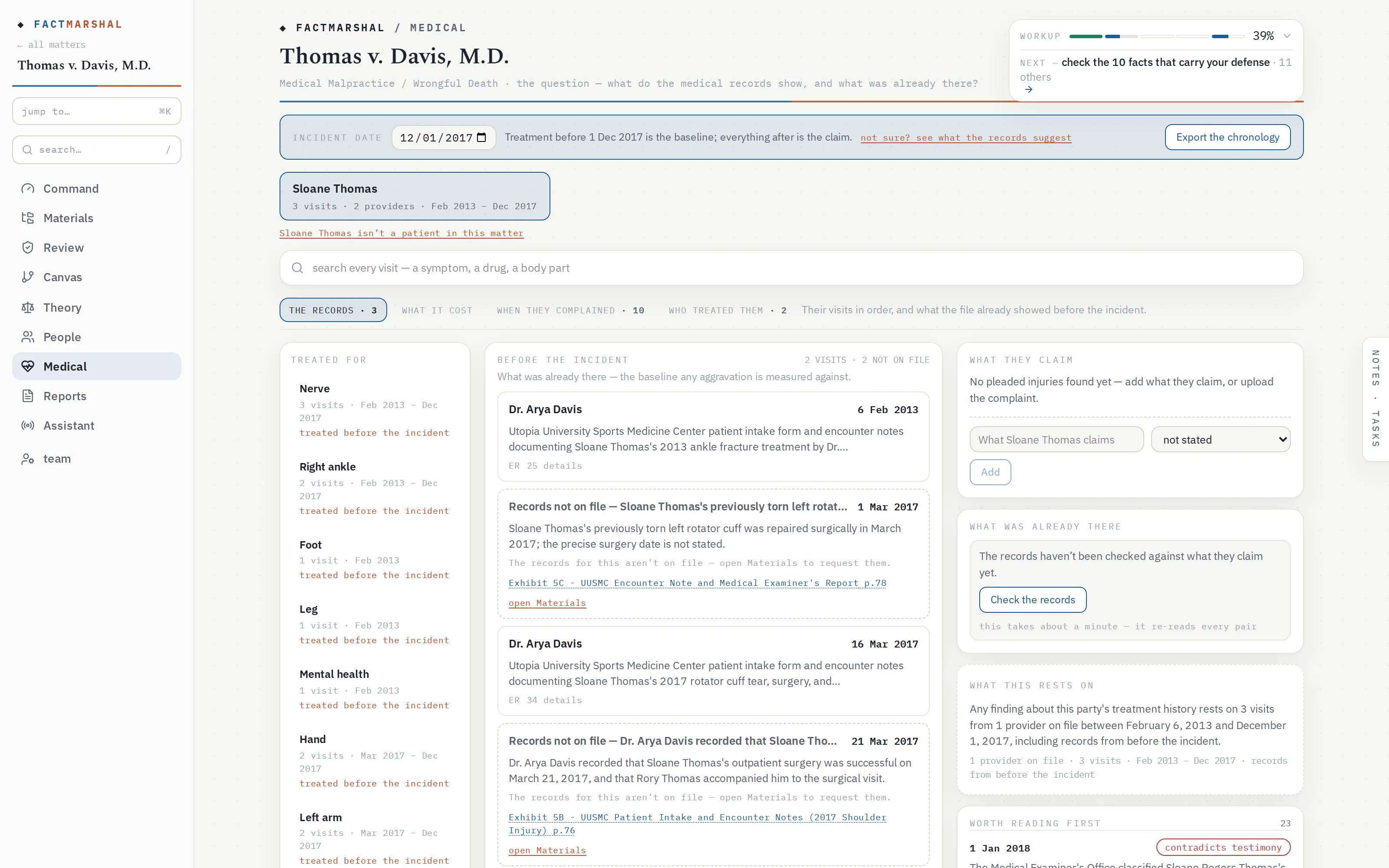
What does medical chronology software actually do?
Given a records production — often thousands of pages, out of order, duplicated, and mixed across providers — the software splits and classifies the documents, reads each page, and extracts the medically significant events: encounters, complaints, findings, diagnoses, procedures, medications, and provider statements. Each event is dated, attributed to its provider, and placed on a single timeline with a citation back to the exact page it came from.
The difference between a good chronology and a dangerous one is verifiability. A summary you can't check is a liability in a deposition; a chronology where every line opens to its source page is work product you can build a case on.
What should attorneys look for?
| Capability | Why it matters |
|---|---|
| Source-page citations on every entry | You will be asked "where does the record say that?" — the answer should be one click, not an afternoon. |
| A verification workflow, not a disclaimer | AI extraction is never perfect. The question is whether errors get caught — by a review queue built for speed, or by opposing counsel. |
| Contradiction detection against testimony | The chronology's highest use is impeachment: "no prior injuries" in an intake form against a two-year-old MRI report. |
| Handles messy productions | Real records arrive as unordered scans with duplicates. Software that needs clean input just moves the work. |
| Matter-level access controls | Medical records are sensitive by definition. Access should be scoped to the people on the matter. |
How FactMarshal builds a verified medical chronology
- Ingest and split. Upload the production as-is; FactMarshal separates and classifies the individual records inside it.
- Extract, pinned to the page. Every event is extracted with its date, provider, and context — and a citation to the exact source page.
- Verify. Entries whose text is verbatim from the record are machine-verified automatically; the rest queue for one-click human review.
- Assemble. The chronology builds itself from the verified record — filterable by provider, body system, or date range, with treatment gaps made visible.
- Cross-examine. Medical events are checked against pleadings and testimony in the same matter, and conflicts are flagged side-by-side.
Software or an outsourced service?
Outsourced chronology services solved this problem before software could. They still fit one-off matters where nobody in-house will ever touch the records. But for a litigation or PI/med-mal practice with steady record volume, software changes the economics: hours instead of weeks, updates as new records arrive instead of re-engagement fees, and — most importantly — a chronology your own team verified rather than a third party's word for it.
Frequently asked questions
- How is chronology software different from a medical chronology service?
- A service sends your records to reviewers and returns a static document weeks later; if new records arrive, you pay and wait again. Software builds the chronology in-house in hours, updates it as the record grows, and keeps every entry linked to its source page so your team can verify anything instantly. Services still make sense for one-off matters with no in-house review capacity.
- How does FactMarshal prevent AI errors in the chronology?
- Three controls: every extracted fact is pinned to the exact source page, so nothing is uncited; facts whose text is verbatim from the record are machine-verified against the document at ingest; and everything else lands in a review queue where your team confirms or corrects entries in one click before relying on them.
- Can it compare the medical records against deposition testimony?
- Yes — that is FactMarshal’s signature capability. Because medical events and testimony live in the same fact record, contradictions between what the records show and what a witness said are surfaced side-by-side with citations to both sources.
- What kinds of records can it read?
- PDF productions of any structure — hospital charts, provider records, imaging reports, billing, pharmacy records — including large mixed productions. FactMarshal splits and classifies the documents before extraction, so one 4,000-page PDF is handled like the many records it actually contains.
- Who can see the records?
- Access is controlled per matter, with lead, member, and viewer roles, and each firm’s data is isolated at the tenant level. Client files are never used to train models.
- What does it cost?
- Pricing depends on firm size and matter volume — request a demo and we’ll walk through it on a real (closed) matter so you can judge the output before talking numbers.